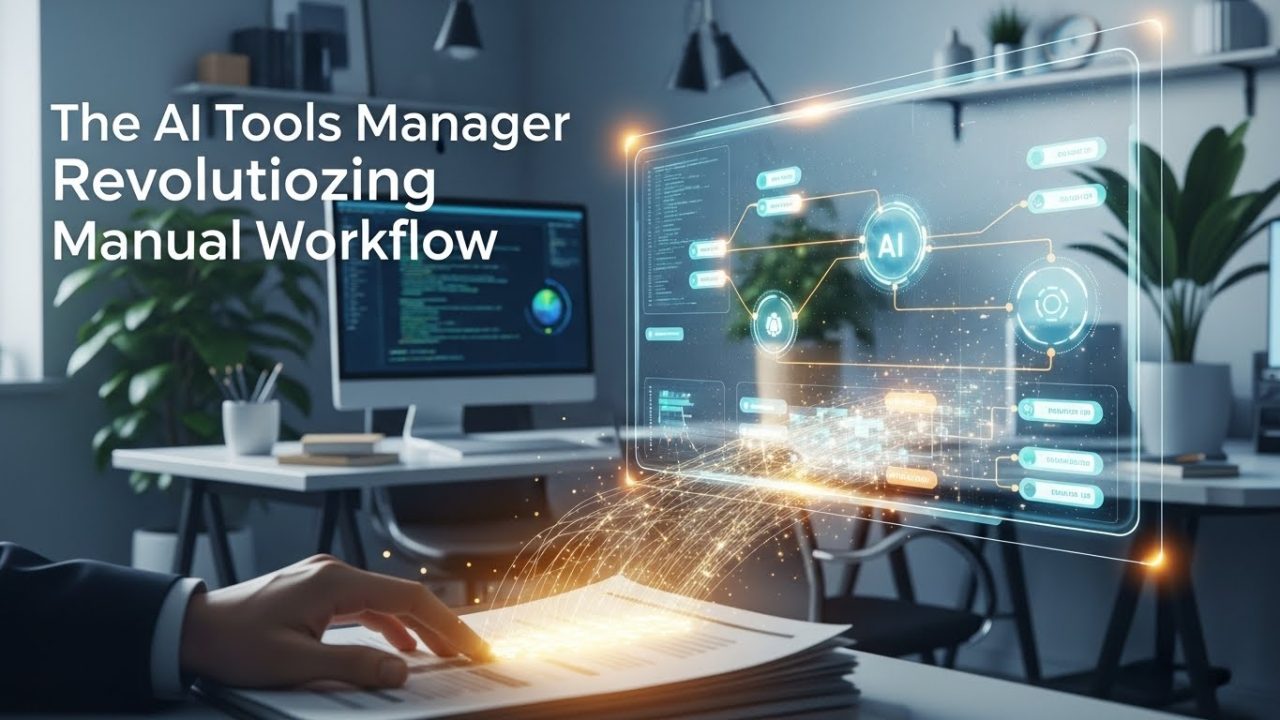
In today’s fast-moving digital world, businesses are constantly looking for ways to work smarter, not harder. That’s where the rise of AI tools managers is changing the game. Instead of relying entirely on slow, repetitive manual processes, teams can now automate routine tasks, reduce human error, and focus more on strategy and creativity. This shift isn’t just about saving time it’s about unlocking a completely new level of efficiency.
But the real revolution lies in how seamlessly AI tools blend with existing manual workflows. They don’t replace human effort; they enhance it. From organizing tasks to analyzing data in seconds, these tools act like a smart assistant that knows exactly what needs to be done and when. As more businesses adopt AI-powered management, it’s clear that the future of productivity will come from a perfect balance between human skills and intelligent automation.
What is an AI Tools Manager
Many people mistakenly equate AI with simple software designed to automate repetitive tasks, like Robotic Process Automation (RPA). However, an AI Tools Manager is far more sophisticated.
It is an Integrated, Intelligent Platform designed to:
- Analyze Data: Process massive datasets quickly.
- Learn: Utilize Machine Learning (ML) to derive insights from your work patterns.
- Adapt: Automatically adjust its functions based on changes in data and the operational environment.
In essence, it’s a self-regulating assistant capable of making data-driven decisions about “what to do” and “how to do it,” a capability entirely absent in manual workflows. Learn more about how AI differs from traditional tools and why it outperforms basic automation.
Beyond Automation

Traditional automation operates primarily on IF-THEN-ELSE logic. If X happens, then do Y. The AI Tools Manager shatters this linear boundary.
The Manual Scenario:
Logging a sales lead into a CRM, manually qualifying it, and assigning it to the appropriate sales representative is a multi-step process demanding significant human attention and time.
With an AI Tools Manager:
The AI doesn’t just log the lead. It performs several intelligent actions:
- Sentiment Analysis: Analyzes the lead’s email or form input to gauge intent.
- Scoring: Scores the lead based on its Business Size and Industry using ML algorithms.
- Intelligent Assignment: Assigns the lead to the sales rep with the highest historical success rate for converting similar clients.
The difference here is not just saving time, but deploying expert-level decision-making at scale.
The Hidden Cost of Manual Workflows
The biggest misconception about manual workflow is that the cost is limited to employee salaries. The truth is, there is a long list of Hidden Costs that erode profitability over the long term.
Manual vs. AI
| Element | Cost in Manual Workflow | AI Tools Manager Solution |
| Error Rate | High: Prone to human errors (data entry, calculation, duplication). | Negligible: Eliminates up to 80% of human errors through validation. |
| Decision Fatigue | Extreme: Mental energy is wasted on low-value, repetitive decisions. | Decision Support: Automates trivial decisions, freeing humans for strategic focus. |
| Scalability | Low: Growth necessitates hiring and training new staff. | Infinite: Scales work capacity seamlessly regardless of volume increase. |
| Time Allocation | Inefficient: 80% of time spent on data gathering, 20% on action. | Efficient: Flips the ratio, allowing humans to focus 80% on action/strategy. |
In a manual setting, 80% of time is often dedicated to data aggregation and reporting, while only 20% is spent on taking meaningful action based on that data. The AI Tools Manager reverses this ratio, empowering humans to adopt a predominantly strategic role.
How AI Tools Managers Spark Revolution

The revolution brought by the AI Tools Manager stems not merely from task automation, but from three core pillars that fundamentally restructure the workflow.
Data Processing and Insight Generation
It is physically impossible for a human to analyze millions of data points, particularly in fields like SEO, Marketing, and financial trading.
- AI Function: The AI Tools Manager ingests data from thousands of sources in seconds, identifies subtle patterns, and generates a truly Actionable Insight that would take a human analyst days or weeks to uncover.
- Example: In SEO, AI not only suggests keywords but identifies which competitor backlinks are most effective and pinpoints exact content gaps you need to fill. Check out AI solutions for managing multiple SEO tools to streamline this process.
Predictive Analytics and Risk Management
Manual work is inherently reactive, based on historical data. AI is predictive.
- AI Function: Machine Learning algorithms analyze historical and current data trends to forecast potential Project Delays, Financial Risks, or Equipment Failures.
- Example: In Project Management, if an unexpected delay occurs in one phase, the AI instantly updates the entire Project Timeline, adjusting Task Dependencies and Resource Allocations, allowing managers to mitigate risk before it becomes a crisis.
Cross-Functional Optimization
In modern business, different departments (Marketing, Sales, Support) often operate in organizational ‘Siloes.’
- AI Function: The AI Tools Manager seamlessly integrates data and workflow across all departments.
- Example: When a lead converts from Marketing, the AI automatically notifies HR about the new client onboarding task, prepares documentation for the Legal team, and triggers the initial invoicing process in Finance—all without any human intervention.
AI Implementation Across Key Industries

The AI Tools Manager is proving to be a game-changer across every industry.
SEO and Digital Marketing
- Manual Task: Manual keyword research, technical audits, content gap analysis.
- AI Revolution: AI automatically identifies high-value Semantic Keywords, monitors Core Web Vitals issues in real-time, and even Reverse-Engineers competitors’ success strategies. This can lead to a time saving of over 40%.
Finance and HR
- Manual Task: Processing expense reports, payroll calculations, resume screening.
- AI Revolution: AI scans and validates invoices, flags financial anomalies (potential fraud), and in HR, screens thousands of resumes in seconds to select the top candidates, dramatically reducing unconscious Bias in hiring.
Project Management
- Manual Task: Resource allocation, scheduling, manual risk reporting.
- AI Revolution: AI intelligently assigns tasks based on team members’ availability and skill sets, predicts Project Bottlenecks, and even analyzes team Sentiment to forecast burnout risk.
AI Tools Manager vs. Traditional Tools
Traditional software (like a basic CRM or Spreadsheet) merely records data, whereas the AI Tools Manager uses that data to learn and decide.
AI Tools Manager vs. Traditional Tools
| Characteristic | Traditional Tools (Basic CRM, Spreadsheets) | AI Tools Manager Platform |
| Data Interaction | Static: Only records and displays data as input. | Dynamic: Analyzes, finds patterns, and makes predictions based on data. |
| Adaptability | Rigid: Requires manual updates or rule changes for shifts in process. | Adaptive: Automatically adjusts functions based on changing data, rules, or environment. |
| Proactivity | Reactive: Waits for human command to execute tasks. | Proactive: Anticipates risks and issues, issuing warnings and automated corrections. |
| Primary Output | Reports, simple charts, and data logs. | Actionable Insights, Automated Next Steps, and Suggested Strategic Decisions. |
Challenges in AI Adoption and Their Solutions

While powerful, adopting AI is not without hurdles.
- 1. Employee Fear (Job Displacement):
- Solution: Frame AI as Job Augmentation rather than replacement. It frees employees to focus on more creative and strategic, high-value tasks.
- 2. Initial Setup Cost and Complexity:
- Solution: Start small with low-risk, high-volume tasks (like data entry). Employ a Gradual Implementation Plan to allow the team to adjust and demonstrate early ROI.
- 3. Data Security and Bias:
- Solution: Ensure robust data encryption protocols. Regularly audit ML models to prevent bias and ensure ethical decision-making.
Human + AI
To rank on the first page of Google, it must be clear that AI isn’t replacing humans—it’s empowering them. The most successful workflow is one that marries human Creative Intelligence with AI’s Speed and Scale.
The Hybrid Model
| Role | Human Expertise | AI Tools Manager (Machine Power) |
| Strategy & Vision | Ultimate Owner: Determining brand tone, ethics, and overall business strategy. | Insight Provider: Supporting the vision with market forecasts and trend analysis. |
| Execution | Creating original, creative content; complex client negotiations; building deep relationships. | Automating repetitive tasks; Data classification and reporting; Low-level decision-making. |
| Quality Control | Final auditing of AI-generated insights or content for context and tone. | Automated error detection; Real-time monitoring; Technical fault correction. |
Future Outlook

The future AI Tools Manager will be even more Predictive and Autonomous.
- Hyper-Automation: AI will combine multiple technologies (RPA, ML, NLP) to automate entire end-to-end business processes, not just individual tasks.
- Emotional AI: The manager will sense and understand employee and customer Sentiment to adjust workload and optimize customer support interactions.
- Autonomous Agents: AI will not only suggest actions but will take steps to complete tasks independently (e.g., launching a marketing campaign within budget or solving a supply chain issue on its own).
Discover the latest AI tools in 2025 shaping tomorrow’s workflows.
Conclusion
“The AI Tools Manager Revolutionizing Manual Workflow” is more than a catchy phrase; it is the current business reality. Managing tools with AI is not just about saving time; it’s about making your organization dramatically smarter, more resilient, and competitive.
You cannot afford to compete with manual labour in a world driven by AI speed. The time has come to offload the burden of repetitive, inefficient manual tasks to AI, freeing your team to focus on strategic thinking and human creativity. Adopting an AI Tools Manager is investing in the future an investment that will begin yielding higher ROI today.
FAQs
1. What is an AI Tools Manager?
An AI Tools Manager is a centralized system that organizes, automates, and optimizes multiple AI tools in one dashboard. Instead of switching between apps, you manage all tasks writing, analysis, automation, research from one place.
2. How does an AI Tools Manager improve manual workflows?
It replaces repetitive manual tasks (copy-paste, data sorting, content creation, reporting) with automated actions. This reduces human error, speeds up processes, and increases productivity without needing technical skills.
3. Which industries benefit most from an AI Tools Manager?
Digital marketing, ecommerce, customer support, finance, HR, and content creation see the biggest improvements. Any industry that relies on repetitive processes or large data sets can benefit.
4. Can an AI Tools Manager help reduce work time?
Yes. It can cut manual work time by up to 50–80% by automating tasks such as writing emails, generating reports, tracking data, and scheduling tasks.
5. Do I need technical knowledge to use an AI Tools Manager?
No most AI managers are built with simple dashboards. You just select the task, enter basic details, and the AI handles the workflow automatically.
6. What features should I look for in a good AI Tools Manager?
Look for automation workflows, task scheduling, multi-AI integration, analytics, team collaboration, templates, and strong data security.
7. Is an AI Tools Manager safe to use?
Yes, if it uses encryption and secure APIs. Always choose a tool with privacy compliance (GDPR, SOC2) and transparent data policies.
8. Can it integrate with tools like ChatGPT, Google Workspace, or Notion?
Most modern AI Tools Managers support integrations with popular platforms, so you can automate content creation, spreadsheets, email workflows, and project management all in one place.
9. How does an AI Tools Manager help teams?
It centralizes tasks, assigns responsibilities, reduces miscommunication, and ensures everyone has access to the same AI-powered resources boosting team efficiency and collaboration.
10. Is it worth investing in an AI Tools Manager for small businesses?
Absolutely. Small businesses save money by reducing manual labor, avoiding extra staffing, and speeding up repetitive processes like marketing, reporting, or customer handling.